Pattaya Baht Bus Guide 2026: Fares, Routes & How to Ride
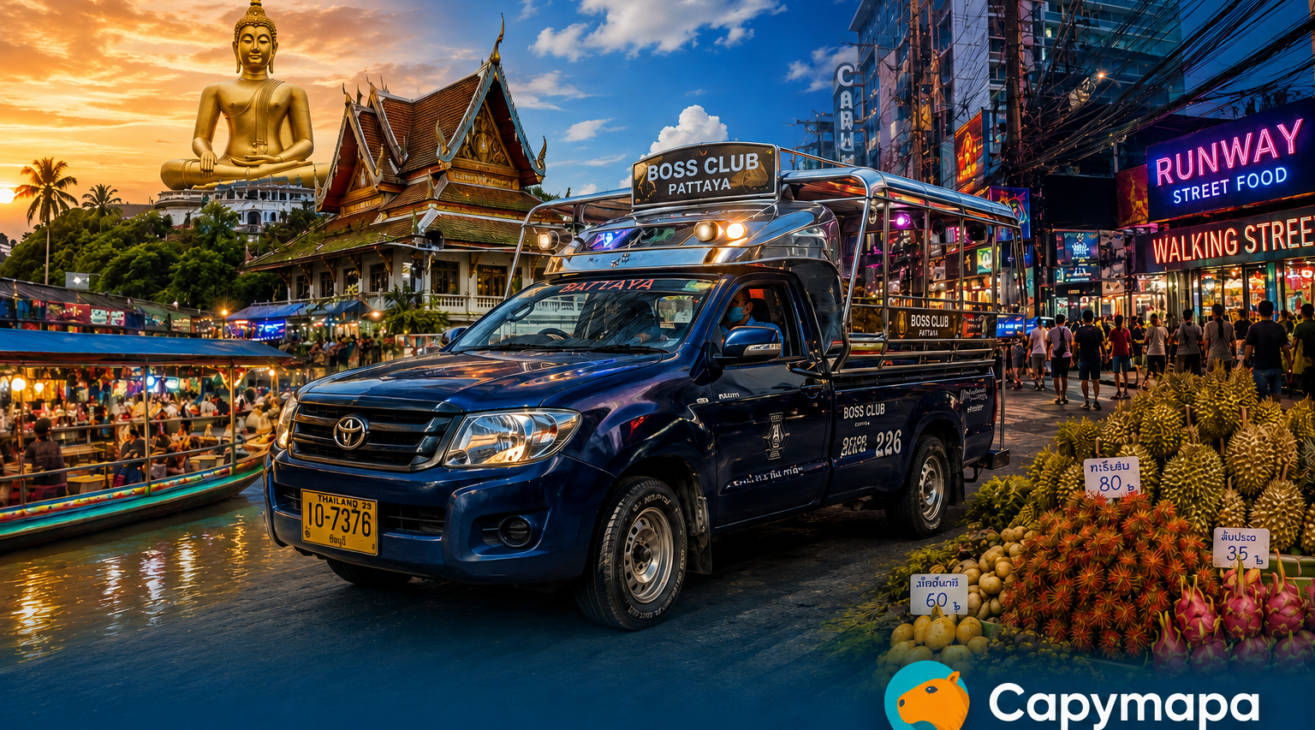
The blue pickup trucks with two benches in the back are baht buses — locally also called songthaews — and in Pattaya they’re the entire public transit system: no metro, no city buses, no marshrutkas. A ride costs less than a bottle of water, right up until you make one specific mistake: asking the driver a question. After that, the same truck turns into a private taxi and the fare jumps into the hundreds of baht.
This guide covers how to ride a baht bus properly: the current fare (it changed for the first time in roughly thirty years in spring 2026), the four working routes, and the stops where trucks always wait for passengers. All of it is also on the Capymapa interactive route planner — it builds a route from wherever you’re standing and shows exactly where to get off.
The 30-second version
Fare in the center
15 baht
Jomtien & Naklua
20 baht
How to flag one
Wave silently
How to get off
Ring the ceiling bell
When to pay
On exit, exact change
Never do this
Don’t ask the driver anything
How much does a baht bus cost in Pattaya in 2026
15–20 baht per ride. The exact number depends on distance: short hops around the city center run 15 baht, the longer legs out to Jomtien and Naklua run 20.
Worth remembering this number specifically, because it’s new. On April 10, 2026, operators officially raised the fare — the first increase in roughly thirty years. Rising diesel prices were cited as the reason; operators haven’t said whether it’s permanent or tied to fuel costs coming back down.
Why this matters to you specifically
Most guides online — including some that update their dates every year — still quote “10 baht” from before the increase. Show up expecting that number and you’ll assume every driver is overcharging you, which makes for an unpleasant first ride. The correct 2026 fare is 15 or 20 baht.
A few payment details worth knowing:
- Pay when you get off, not when you get on. Step down, walk up to the driver’s window, hand over the fare, and go.
- Bring exact change if you can. Drivers will make change, but not always cheerfully — handing over a 100-baht note for a 15-baht ride can come across as a tip you didn’t mean to give.
- The fare doesn’t change with how many people are riding. You pay for yourself, no matter how crowded the truck bed is.
- The fare doesn’t change with how far you actually go within a leg — it’s a flat rate per zone, not per kilometer.
How to flag down a baht bus
Here’s the part that trips up first-timers: there are no official stops. No signs, no shelters, no timetable. Each truck runs its own loop and picks people up anywhere along the way.
The routine:
- Stand on the side of the road facing the direction you want to go — this matters, since a lot of Pattaya’s main roads are one-way. A truck coming from the wrong side will take you the opposite way.
- Wait for a truck that’s already moving in traffic, not one parked at the curb. The difference matters — see the next section.
- Wave your hand down, palm toward the ground. It’s not the raised-arm taxi hail you might be used to.
- Climb in and sit down. That’s it. No conversation, no “how much,” no nod to the driver. He already knows where he’s going, and you should already know too.
If you’re not sure which truck goes where, check the route planner first — it shows which leg you’re on and which direction to flag.
The one mistake: shared route vs. private charter
The exact same blue pickup can be two completely different services, and one sentence from you flips it from one to the other.
Shared route (what you want)
Moving in traffic, already has passengers on board. You wave silently, hop in, ring the bell to exit, and pay 15–20 baht.
Private charter (not what you want)
Parked empty at a curb, driver calls out to you first. Goes only where you tell it — and charges taxi-level fares for the privilege, often several hundred baht.
The switch between these two modes is the question you ask. Say “Do you go to Central?” or “How much to Jomtien?” and the driver hears a request for a private ride — not an unreasonable interpretation, since that’s literally what you asked for. It’s now a different service with a different price.
The one-sentence rule
While you stay silent, you’re a passenger on a 15-baht shared ride. The moment you speak, you’re a taxi customer. Silence has a dollar value here.
How to tell the two apart before you raise your hand:
- Parked and empty outside Central Festival, Terminal 21, or on a busy soi corner — almost certainly a charter. Keep walking.
- Driver waves you over or calls out — charter. A shared-route driver isn’t chasing down fares that badly.
- Already moving, with people in the back — shared route. Flag it with confidence.
- Driver names a price before you’re even in — you’re already in charter mode. Step out, nothing lost, and flag the next one.
One exception: stops at the end of a route, where trucks line up specifically to wait for passengers, are supposed to be idle and empty — that’s normal there. More on those below.
How to get off where you want
Somewhere on the ceiling of the truck bed, usually near the cab, there’s a buzzer — sometimes a couple of them spaced along the rail. Press it and it rings up front; the driver pulls to the curb.
Ring it 20–30 meters before your stop, not right on top of it. The driver needs a few seconds to merge over, especially in Beach Road traffic — ring too late and you’ll get dropped fifty meters past where you wanted.
After that: get out quickly without holding up the truck, walk around behind it (not in front — that’s the blind spot), step up to the driver’s window, and pay. A quick “khop khun krap/ka” is a nice touch, not a requirement.
If the buzzer’s dead — it happens — knock on the roof of the truck bed with your knuckles. Universally understood signal, nobody will be confused.
The main baht bus routes in Pattaya
Four legs cover the city. There’s no official numbering or timetable — these are long-standing loops trucks have run for decades. All four are drawn as lines on the Capymapa map.
Second Road — northbound
The workhorse route. Starts at Second Rd and South Pattaya Rd near Walking Street and runs due north on the one-way Second Road: past Mike Shopping Mall, the back of Central Festival, Alcazar, Central Marina, Terminal 21, ending at the Dolphin Circle. Trucks loop back south from there via Beach Road.
💰 15 baht · 🕐 roughly 6 AM–8 PM
Beach Road — southbound
The other half of the same loop. From the Dolphin Circle south along the beachfront: Central Festival, Royal Garden Plaza, to the entrance of Walking Street, where it turns onto South Pattaya Rd and reaches the start of Second Road — most riders get off right at this junction.
💰 15 baht · 🕐 roughly 6 AM–8 PM · expect heavy traffic on Beach Road in the evening
Jomtien ↔ Central Pattaya
Connects laid-back Jomtien with the city center. Runs north from the Jomtien waterfront, climbs Thappraya Road past Pratamnak Hill and Pattaya Park, and reaches South Pattaya Rd near Wat Chaimongkol market — a five-minute walk from Walking Street from there. Trucks typically turn around near Chaiyapruk Road.
💰 20 baht — this is the long leg · 🕐 roughly 6 AM–8 PM
Naklua ↔ Dolphin Circle
The northern route: from the Dolphin Circle up Naklua Road past sois 16 and 18 and the Sanctuary of Truth, ending at the Lan Pho seafood market. Worth the trip for fresh crab and lobster straight off the ice. The return leg follows the same road south without detouring into side streets.
💰 20 baht · 🕐 roughly 7 AM–6 PM · aim to arrive before 4 PM for the best seafood selection
Baht bus stops: where trucks always wait
There are no official stops, but there are staging points — endpoints and turnaround spots where trucks line up specifically to wait for passengers. These are the only places in the city where transit is guaranteed even if the road traffic looks empty.
Two situations where knowing them helps: you’ve been waving for ten minutes without a matching truck passing, or you need to switch from one leg to another.
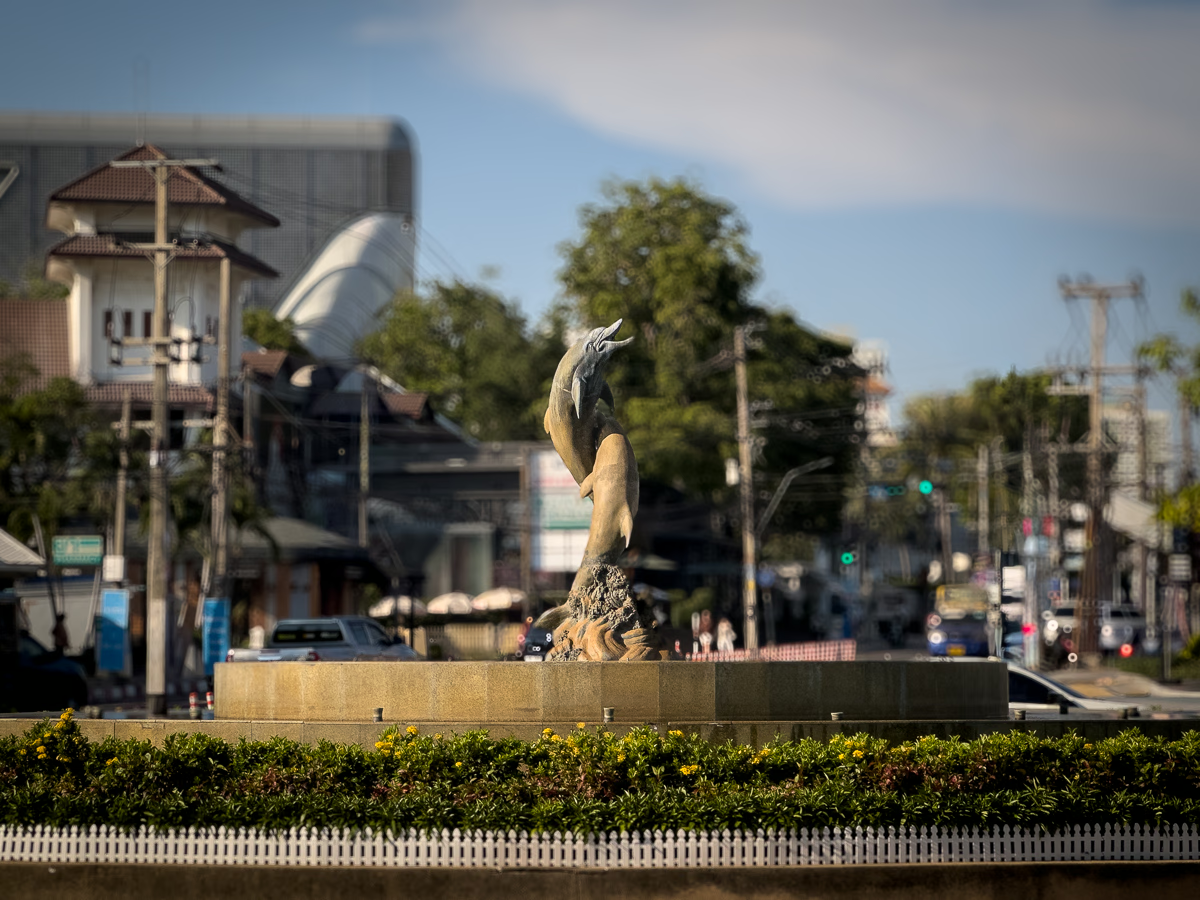
Dolphin Circle / Terminal 21
The main transit hub of North Pattaya, where three directions meet: south down Beach Road, north to Naklua, and — cross the road to Terminal 21 — onto Second Road. Trucks are parked here at nearly all hours of the operating day.
📍 North Pattaya · three-way transfer point
See on the map →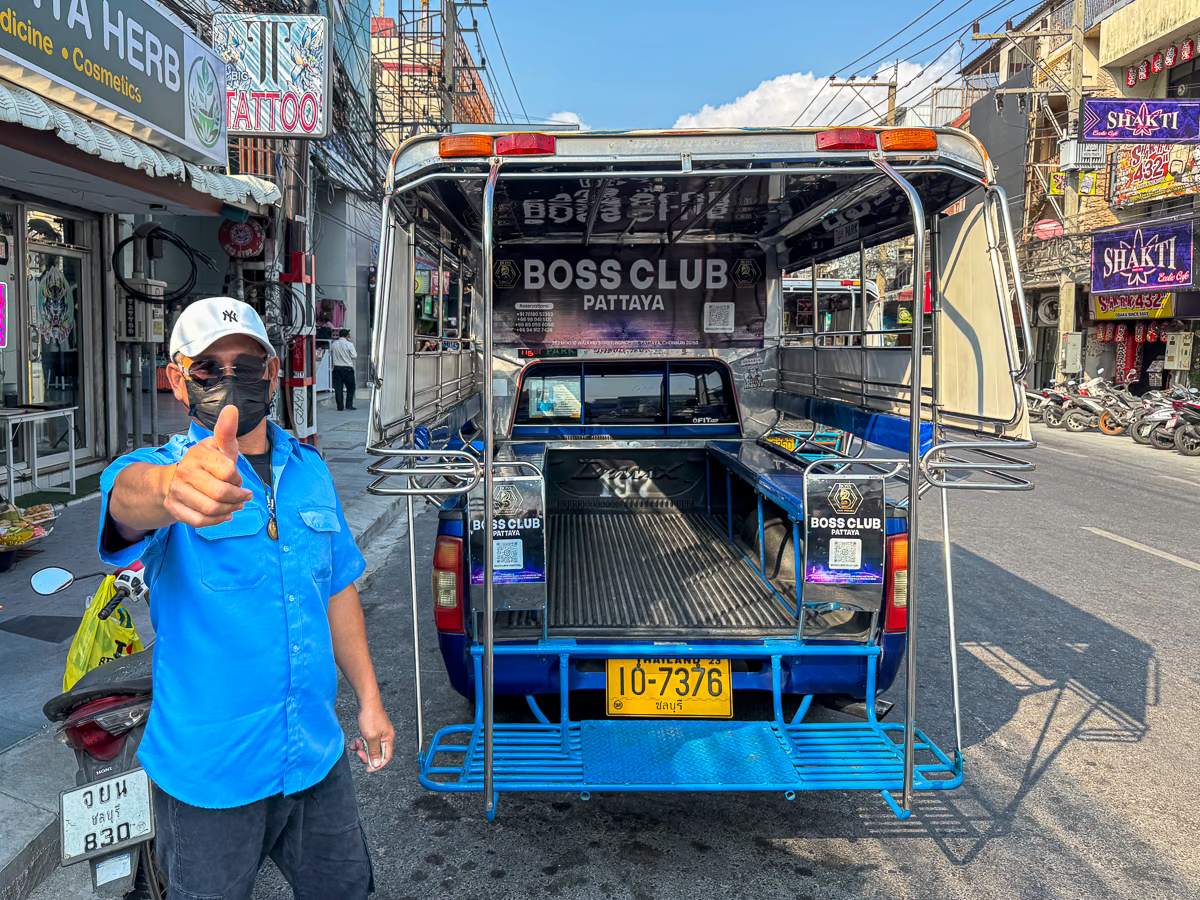
Second Rd × South Pattaya Rd (near Mike Shopping Mall)
The southern counterpart to Dolphin Circle: trucks arriving from Beach Road gather here, and it’s also where the Second Road loop starts. Five minutes on foot from Walking Street. Coming back from Jomtien and heading into the center — this is where you transfer.
📍 South Pattaya · start of the Second Road loop
See on the map →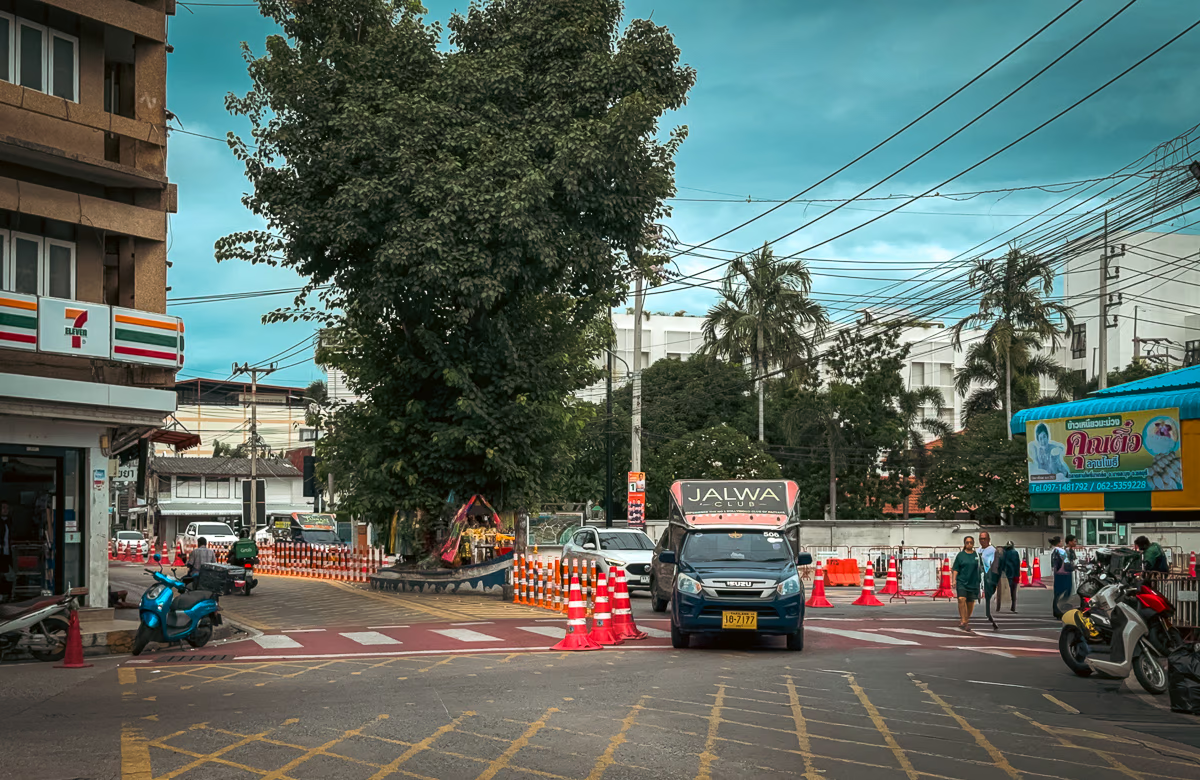
Lan Pho Market, Naklua
The end of the line for the northern leg, right at the seafood market gates. Trucks turn around here and head south. Handy in practice: buy your seafood, walk out the gate, hop in the first truck in line.
📍 Naklua, at Lan Pho market · end of the north leg
See on the map →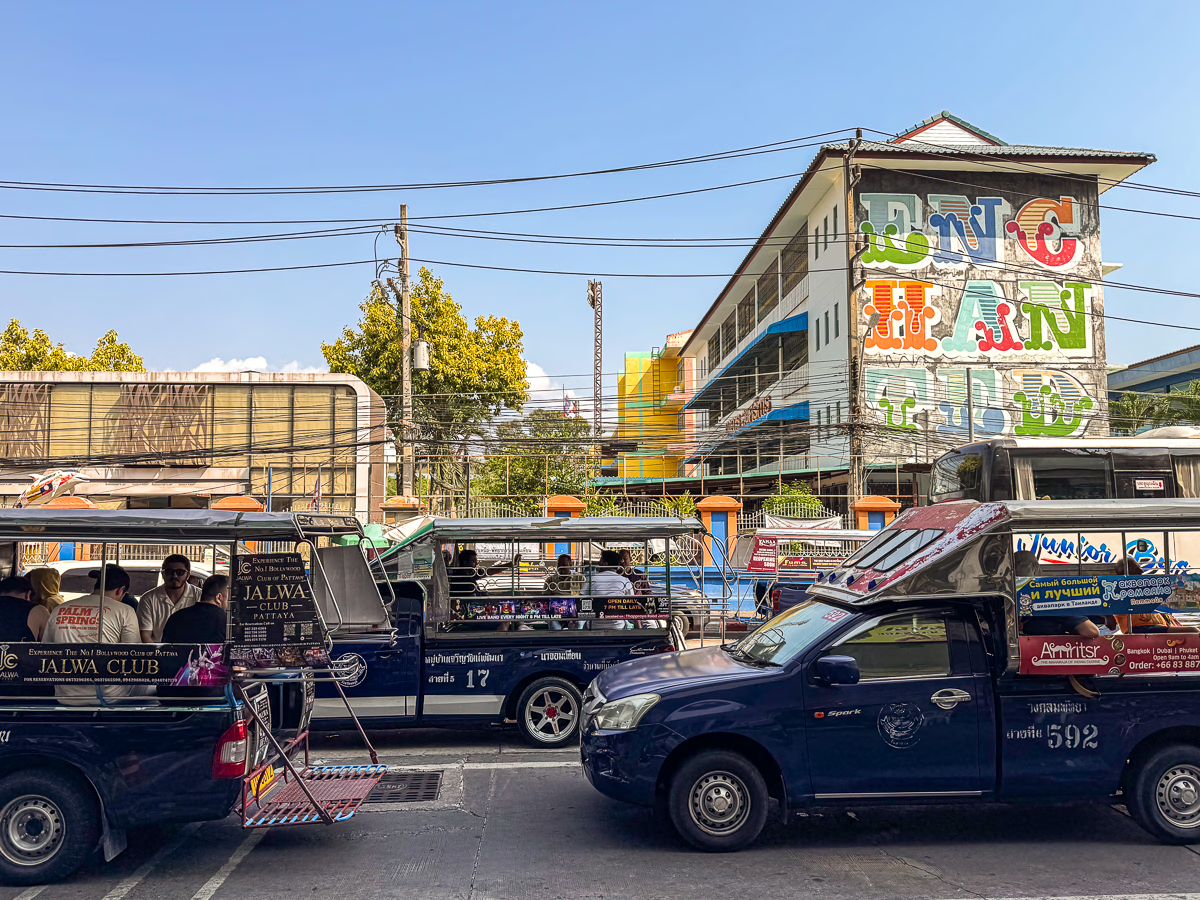
Jomtien, Chaiyapruk × Jomtien Beach Rd
The turnaround point of the southern leg, right on the Jomtien waterfront. Trucks head north from here up the beach and on toward the center via Thappraya Road. If you’re staying in Jomtien, this is your starting point into town.
📍 Jomtien waterfront · turnaround of the south leg
See on the map →Transferring between routes
There’s no direct baht bus from Jomtien to North Pattaya — any long crosstown trip means two rides with a transfer, and you pay for each leg separately.
- Jomtien to North Pattaya: board at the Jomtien waterfront, ride to the South Pattaya Rd junction (20 baht). Cross the road, flag a truck on Second Road, continue north (15 baht). Total: 35 baht, about forty minutes.
- Naklua to the center: ride to Dolphin Circle (20 baht), cross to Terminal 21, flag a Second Road truck (15 baht).
Both transfers happen at the staging points listed above — trucks are always waiting there, so there’s no real wait involved.
Baht buses at night, and what to use instead
Main routes run roughly from 6 AM to 8 PM. After that, trucks thin out gradually — some keep circling the center until midnight, but on unpredictable intervals, and the longer legs stop running earlier.
After dark, better options are:
- Grab or Bolt — both apps run around the clock in Pattaya, the fare is fixed before you ride, no negotiating required. Every place card on Capymapa has a direct call-a-ride button.
- Motorbike taxis — drivers in colored vests on street corners. Fast and cheap, but no helmets and no lit lanes at night — ride at your own risk.
- The same baht bus, chartered — at night, going private is a reasonable choice. Just agree on the price up front and understand you’re paying taxi rates.
And separately: baht buses don’t run to either airport — not Suvarnabhumi, not U-Tapao. For an airport transfer, use Grab, a pre-booked transfer, or the airport shuttle bus.
Five mistakes that cost tourists extra
- Asking the driver where he’s going. The single most expensive sentence you can say in Pattaya — turns a 15-baht ride into several hundred.
- Hopping into an empty parked truck downtown. If it’s idle somewhere other than a staging point, it’s a taxi waiting specifically for you.
- Paying when you board. Payment is always on exit. Paying upfront is itself a sign you’ve slipped into charter mode.
- Flagging a truck from the wrong side of the street. Second Road is one-way — there’s no such thing as catching it “back” from the opposite curb; you’ll ride the whole loop instead.
- Trusting an old guide’s price. “10 baht” hasn’t been accurate since April 2026 — arguing the point with a driver won’t get you anywhere.
Plan your route right now
The Capymapa planner uses your GPS location to show which baht bus to catch, where to get off, and what it’ll cost.
Open the route planner →Frequently asked questions
How much does a baht bus cost in Pattaya in 2026?
15 to 20 baht depending on distance: 15 baht around the city center (Beach Road, Second Road, Soi Buakhao), 20 baht on the longer legs to Jomtien and Naklua. The fare was raised on April 10, 2026 — the first increase in roughly thirty years.
What’s the difference between a baht bus and a songthaew?
Same vehicle — “baht bus” is the English nickname (it used to cost one baht), “songthaew” is the Thai name, meaning “two rows,” for the two facing benches in the back. In Pattaya they’re interchangeable terms for the same blue shared pickup trucks.
Where are the baht bus stops in Pattaya?
There aren’t any official stops — you flag a truck anywhere along its route and ring the bell to get off wherever you like. There are four staging points where trucks always wait, though: Dolphin Circle, the Second Rd/South Pattaya Rd junction, Lan Pho Market in Naklua, and the Jomtien waterfront turnaround.
How do I signal a baht bus to stop?
Press the buzzer on the ceiling of the truck bed 20–30 meters before your stop — the driver needs time to pull over. If the buzzer isn’t working, knock on the roof. Pay after you step down, at the driver’s window.
Why shouldn’t I ask the driver where he’s going?
The question reads as a request for a private ride, and the same truck becomes a taxi charging several hundred baht instead of fifteen. Figure out your route beforehand and approach the truck without saying anything.
Do baht buses run at night?
Main routes run roughly 6 AM to 8 PM. After that, service gets sparse and unpredictable. At night, Grab or Bolt are the better option — the fare is set in the app before you ride.
Can I take a baht bus from the airport?
No — baht bus routes only run within the city. From Suvarnabhumi or U-Tapao, use Grab, a pre-booked transfer, or the airport shuttle bus.
Where can I see baht bus routes on a map?
On the Capymapa interactive planner — it builds a route from your GPS location, shows where to get on and off, and calculates the fare. All four routes and stops are also on the Pattaya map.